C - Preprocessor Directives
C - Preprocessor Directives
- In C Language preprocessor is more or less the own language which can be a very powerful tool to the programmer .
- All the preprocessor directives or commands begin with “#” .
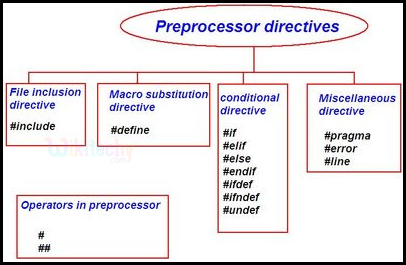
- Below is the list of preprocessor directives that C language offers .
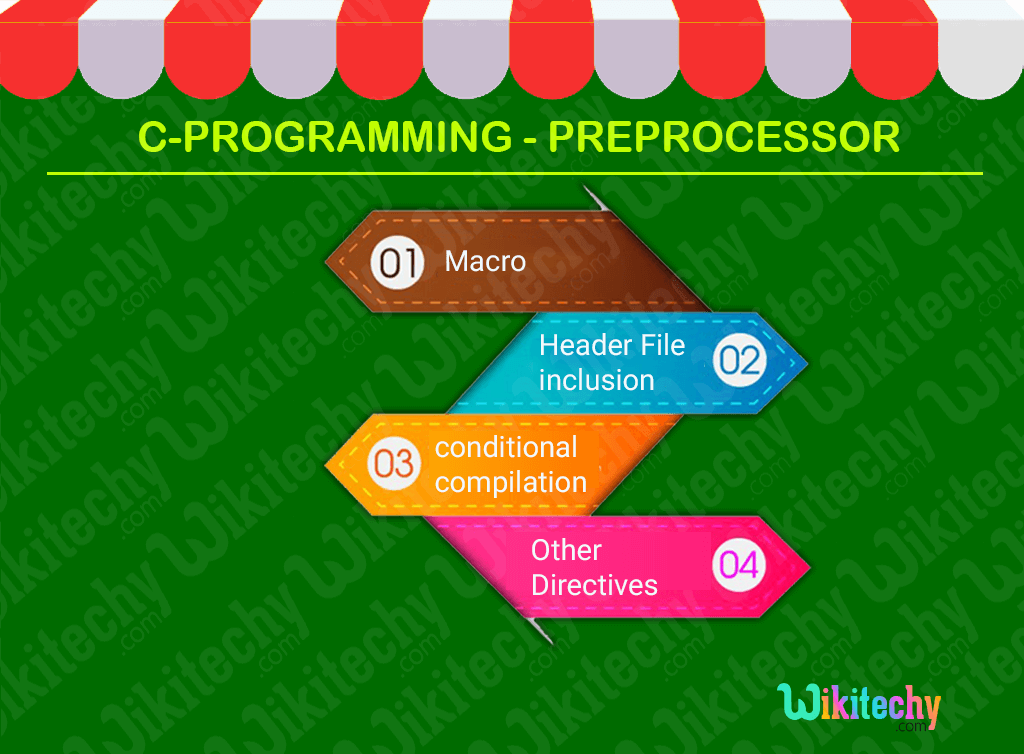
| Preprocessors | Syntax | Description |
|---|---|---|
| Macro | #define | This macro defines constant value and can be any of the basic data types. |
| Header file inclusion | #include <file_name> | The source code of the file “file_name” is included in the main program at the specified place |
| Conditional compilation | #ifdef, #endif, #if, #else, #ifndef | Set of commands are included or excluded in source program before compilation with respect to the condition |
| Other directives | #undef, #pragma | #undef is used to undefine a defined macro variable. #Pragma is used to call a function before and after main function in a C program |
- It must be the first nonblank character, and for readability, a preprocessor directive should begin in the first column.
- The following section lists down all the important preprocessor directives :
| Directive | Description |
|---|---|
| #define | Substitutes a preprocessor macro. |
| #include | Inserts a particular header from another file. |
| #undef | Undefines a preprocessor macro.. |
| #ifdef | Returns true if this macro is defined.. |
| #ifndef | Returns true if this macro is not defined. |
| #if | Tests if a compile time condition is true.. |
| #else | The alternative for #if. |
| #elif | #else and #if in one statement.. |
| #endif | Ends preprocessor conditional. |
| #error | Prints error message on stderr. |
| #pragma | Issues special commands to the compiler, using a standardized method.. |
- Use of the preprocessor in C programming :
- Programs easier to develop,
- Easier to read,
- Easier to modify